





Stats SA Data Breach: What South African Organisations Need to Know
A recent cybersecurity incident affecting Statistics South Africa (Stats SA) has become an important reminder for every organisation that processes and stores employee, applicant, or contractor data. In the context of a data breach South Africabusinesses can learn from, Stats SA confirmed on the 29th of March 2026 that one of its human resources databases was breached, specifically the system used by job seekers to apply online. The organisation also said it was working within a broader government response.
For South African organisations, the lesson is clear: HR systems are no longer administrative tools sitting quietly in the background. They are now high-value targets. These platforms often hold identity numbers, CVs, qualifications, employment history, contact details, and other personal information that criminals can use for fraud, phishing, identity theft, or further attacks. Under POPIA, personal information must be processed securely, and breaches must be handled seriously with strong personal information security measures.
One of the biggest mistakes businesses make is assuming their cybersecurity risk sits only in finance systems or customer-facing platforms. In reality, HR and recruitment databases are attractive because they contain large volumes of structured personal information. In many organisations, these systems also have less oversight than banking, ERP, or production systems. That makes them easier to exploit, which is why HR data security deserves far more attention.
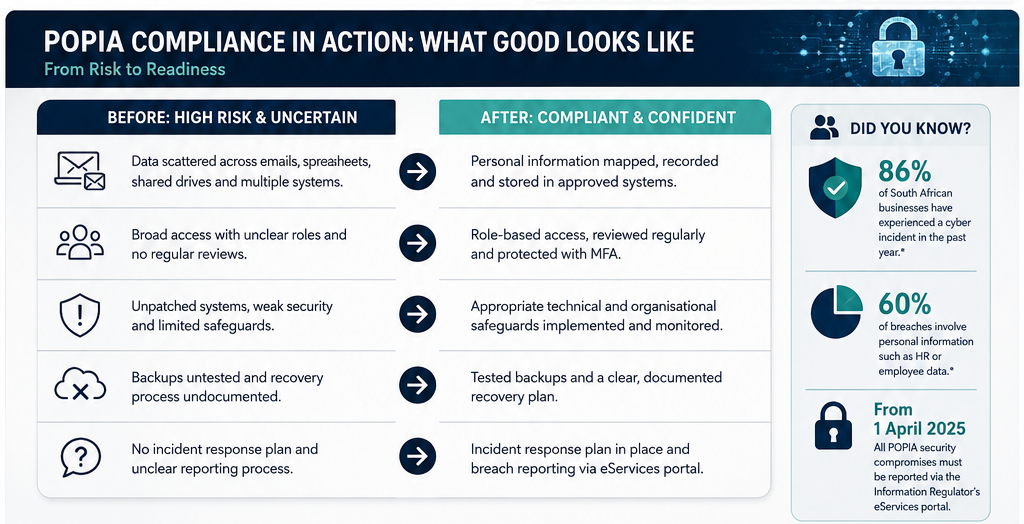
South African organisations should use the Stats SA incident as a trigger to review four areas immediately. The first is access control. Only authorised users should have access to HR data, and that access should be role-based, regularly reviewed, and protected with multi-factor authentication. The second is system maintenance. Unpatched systems, misconfigurations, and unsupported applications remain common entry points for attackers. The third is backup and recovery readiness. Businesses need tested backups and a clear recovery process, not only backup files sitting somewhere in the cloud. The fourth is incident response. Teams should know who investigates, who reports, who communicates with affected individuals, and how evidence is preserved through an effective incident response plan.

This incident also highlights a governance issue. Cybersecurity is not only an IT responsibility. HR leaders, compliance teams, executive management, and legal teams all need to understand what personal information they process, why they process it, and what would happen if that data were exposed. That is where cybersecurity governance becomes essential.
The strongest response is not panic. It is preparation. South African organisations that treat HR data as a critical asset, rather than routine admin information, will be in a far better position to prevent breaches and respond properly when incidents occur.
South African businesses can no longer treat POPIA compliance as a once off legal exercise. It now sits at the centre of how organisations manage personal information, reduce risks, build trust, and respond to security incidents. The Information Regulator continues to publish guidance on and security compromise reporting, and since 1 April 2025 security compromises under section 22 must be reported through the Regulator’s eServices portal.
For many organisations, the challenge is not understanding that POPIA matters. The challenge is knowing what practical compliance looks like in daily operations. A policy on a shared drive is not enough. Real compliance means understanding what data you hold, why you hold it, who can access it, how it is protected, and what happens when something goes wrong. That is where many businesses still fall short.
What POPIA compliance means for South African businesses
At its core, POPIA exists to protect personal information processed by public and private bodies in South Africa. The Act provides a framework for lawful processing and places responsibilities on organisations that decide why and how personal information is processed.
In practice, POPIA compliance means more than publishing a privacy notice. It means creating a consistent and defensible approach to collecting, storing, using, sharing, retaining, and securing personal information. That includes customer data, employee records, supplier contacts, marketing databases, website enquiries, payroll details, and recruitment information.
For South African businesses, this is not only a legal issue. It is an operational discipline. When teams understand their data properly, they make better decisions about access, retention, technology, supplier management, and incident response. Compliance then becomes part of good business practice rather than a separate exercise done only when someone asks for it.
Why POPIA compliance matters in 2026
The business case for POPIA compliance is now stronger than ever.
Trust and reputation
Customers, employees, and partners want to know that their information is handled responsibly. A business that takes privacy seriously communicates maturity, discipline, and credibility.
Risk reduction
Good compliance reduces the likelihood of unauthorised access, poor handling, and weak internal practices. It also improves an organisation’s ability to respond when something goes wrong.
Improved governance
POPIA forces businesses to understand their information flows. That clarity often improves records management, role definition, accountability, and oversight.
Practical readiness
The Information Regulator has made it clear that security compromises must be reported through the eServices portal, and its fact sheet says responsible parties should notify the Regulator and the data subject as soon as it is reasonably certain that a security compromise has occurred. The compromise does not need to be fully confirmed before it is reported.
That means organisations need more than intention; they need readiness.
Who needs to comply with POPIA
A common mistake is assuming POPIA only applies to large companies or heavily regulated sectors. In reality, POPIA applies widely to public and private bodies that process personal information in South Africa, subject to the Act and its scope.
If your business collects or uses names, identity numbers, contact details, addresses, financial information, CVs, performance records, or online form submissions, POPIA is relevant. That includes:
- professional services firms
- software and technology companies
- training providers
- medical and health-related organisations
- retailers and e-commerce businesses
- schools and education providers
- non-profits and associations
- employers of every size
If personal information moves through your business, POPIA compliance should already be on your agenda.
Why this matters
Businesses often consider privacy compliance paperwork. In reality, it affects the way information moves throughout the organisation.
Time efficiency
When data flows are mapped properly, staff spend less time searching for records, clarifying ownership, and fixing avoidable mistakes.
Audit ready formatting
A structured POPIA approach produces clearer evidence. Policies, notices, registers, and response records become easier to maintain and review.
Risk reduction
Stronger access control, improved retention practices, and clearer responsibilities reduce the chance of preventable incidents.
Knowledge transfer
When compliance is documented in a practical way, new staff and service providers can understand the process faster.
The role of the Information Officer in POPIA compliance
The plays a central role in POPIA compliance. The Information Regulator’s guidance note explains the obligations and liabilities of Information Officers and Deputy Information Officers, and it states that it is the duty of the responsible party to ensure that the Information Officer is registered with the Regulator.
This role should never be treated as a name on a form only. An effective Information Officer helps coordinate compliance across legal, IT, HR, operations, and leadership. That includes helping the organisation:
- understand what personal information it processes
- oversee privacy notices and internal policies
- support training and awareness
- coordinate with technical teams on controls
- support data subject request handling
- guide reporting and response when incidents occur
In many organisations, POPIA fails not because no policy exists, but because no one owns the day-to-day reality of compliance.
How to build a practical POPIA compliance framework
A practical POPIA framework does not need to be overly complex. It needs to reflect how your business actually works.
Identify the personal information you collect
Start by listing the personal information your organisation collects and uses. This can include employee files, customer profiles, website form submissions, supplier contacts, application forms, support tickets, invoices, and marketing databases.
Be specific. Broad categories are not enough. Teams should understand what information is collected, from whom, for what purpose, and by which system or process.
Map where the data is stored
Once you know what information exists, identify where it is stored. This may include cloud platforms, CRM systems, HR software, finance tools, collaboration platforms, email archives, laptops, shared drives, and backups.
This step matters because many organisations underestimate how widely personal information is spread across the business. Without this visibility, controls remain inconsistent.
Strengthen access control
Access control is one of the most practical and important safeguards in POPIA compliance. Not every employee should have access to every record. Access should follow role, need, and responsibility.
A useful review includes:
- who can view personal information
- who can edit or export it
- who can create new user access
- how leavers are removed from systems
- whether multi-factor authentication is enabled where appropriate
Weak access control creates unnecessary exposure, especially in HR, finance, customer support, and shared collaboration platforms.
Apply security safeguards
POPIA requires responsible parties to secure the integrity and confidentiality of personal information by taking appropriate, reasonable technical and organisational measures.
In practice, security safeguards may include:
- secure passwords and authentication controls
- device security and patch management
- encrypted storage or transmission where appropriate
- backup protection and testing
- supplier due diligence
- staff training and awareness
- clear document handling rules
- monitoring and logging for critical systems
Reasonable measures will differ by business size, risk level, and processing activity. The point is not to copy another organisation’s control system. The point is to implement measures that are appropriate for your own environment and risks.

Example: POPIA compliance in a growing business
Imagine a South African training company with a main website, an e-commerce platform, and an e-learning portal. It processes customer information, learner records, payment details through service providers, staff files, and marketing contacts.
Without structure, personal information may end up scattered across email inboxes, spreadsheets, website forms, shared drives, and third-party systems. Access is broad. Retention is unclear. Incident handling is informal.
A practical POPIA compliance approach would include:
- a register of systems and data types
- a named Information Officer and delegated responsibilities
- clear privacy notices and internal procedures
- restricted access to learner, customer, and staff records
- supplier reviews for hosted platforms
- an incident response process for security events
- records of actions taken when a compromise occurs
This is where POPIA becomes useful. It turns uncertainty into structure.
Data breach reporting under POPIA
One of the most important areas of compliance is data breach reporting.
The Information Regulator’s website states that, from 1 April 2025, all security compromise notifications in terms of section 22 of POPIA should be reported through the eServices portal. The Regulator also provides a step-by-step guide for reporting security compromises online.
Its fact sheet explains that a security compromise can involve the accidental or unlawful destruction, loss, alteration, unauthorised disclosure of, or access to personal information. It also states that the responsible party should notify the Regulator and the data subject as soon as it is reasonably sure that a security compromise has occurred.
That has real implications for business readiness. Organisations should know in advance:
- who identifies and escalates the incident
- who investigates the likely scope
- who decides on notification
- who submits through the portal
- who communicates with affected individuals
- what evidence is kept
If those decisions are being made for the first time during a live incident, the organisation is already behind.
A word from the compliance perspective
A common issue in POPIA programmes is the tick-box approach. Businesses write a policy, assign a title, and assume they are covered.
That is not how effective compliance works.
A stronger approach is to ask simple operational questions:
- Do we know what personal information we hold?
- Do we know who can access it?
- Do we know how long we keep it?
- Do we know what to do if it is exposed?
- Can we prove what action we took?
That is the difference between paperwork and evidence.
Common POPIA compliance mistakes South African businesses make
Several patterns appear again and again…
The first is over-reliance on templates. Templates are useful starting points, but they do not prove that a business has understood its own systems and risks.
The second is weak ownership. If no one actively drives compliance, policies drift away from reality.
The third is poor visibility. Many businesses do not know where all their personal information sits, especially across older files, email, and third-party tools.
The fourth is weak incident planning. Businesses often think about incident response only after a compromise has happened.
The fifth is assuming that compliance belongs only to legal teams. In practice, POPIA requires cooperation across operations, HR, IT, marketing, and leadership.
Customisation that proves conformance
A practical POPIA programme should be tailored to your business, not copied from another one.
Use this checklist as a guide:
- align procedures to actual business processes
- define responsibilities clearly
- keep evidence of reviews, decisions, and actions
- link privacy controls to real systems and records
- review suppliers that process personal information
- connect incident response to reporting requirements
- revisit controls as your business changes
Customisation is what turns compliance language into operational reality.
WWISE’s thoughts on POPIA compliance
POPIA compliance is not about creating the longest policy set or the most legal-sounding documents. It is about building a business that handles personal information responsibly, applies sensible security safeguards, manages access control properly, and responds well when incidents occur.
For South African businesses in 2026, the organisations that do these tasks well will be the ones that combine governance with practical execution. They will know their data, understand their responsibilities, and act with confidence when issues arise.
If your organisation is reviewing privacy obligations, strengthening controls, or improving readiness for breach reporting, this is the right time to turn POPIA compliance into a practical business capability.
What WWISE can do for YOU
Need help improving POPIA compliance in your organisation? Speak to our team about practical support for governance, security controls, and compliance readiness.