







AI In Software Development in South Africa
Artificial intelligence is changing how software is planned, built, tested, and maintained. South African businesses are paying close attention, but many are still asking the same question: how do we use AI software development without creating new risks?
The answer is not to add AI to every system. The answer is to use it where it creates measurable value, supports business goals, and can be managed responsibly. For South African companies, AI in custom software development should be treated as a business capability, not a trend. It needs clear use cases, strong governance, reliable data, proper testing, and human oversight.
Why AI software development matters
AI software development can help companies build smarter, faster, and more responsive systems. It can support internal teams, improve customer experiences, reduce manual work, and help organisations make improved use of the data they already hold.
In custom software development, AI can be used to:
• automate document processing
• improve customer support workflows
• detect unusual activity or system anomalies
• summarise internal knowledge
• assist teams with repetitive tasks
• improve search and reporting functions
• support software testing and quality checks
These benefits are useful, but they should not distract from the risks. AI systems can introduce concerns around privacy, accuracy, bias, explainability, cybersecurity, and accountability. This is why South African companies need to approach AI implementation with discipline.
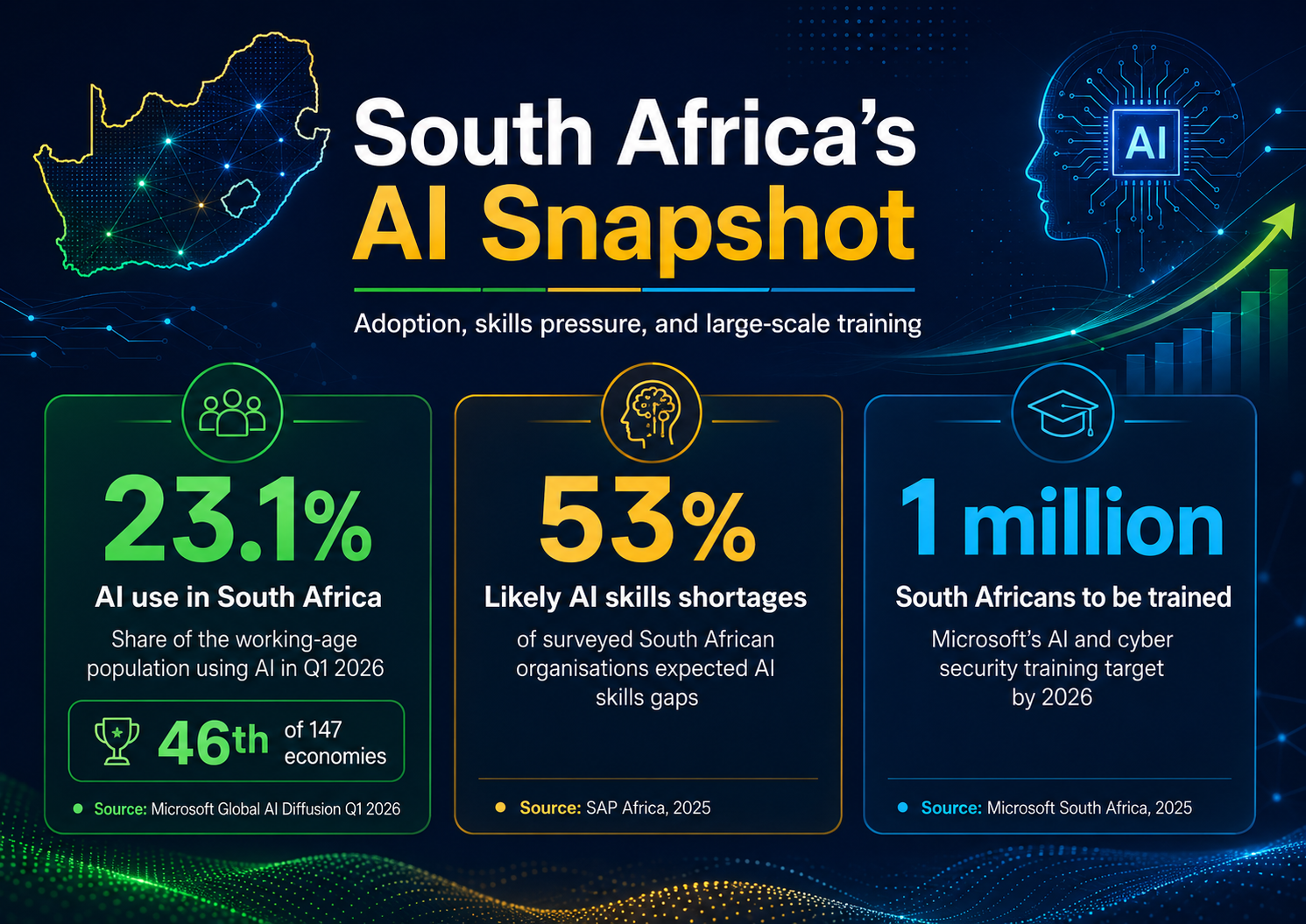
The South African AI context
South Africa’s AI governance environment is still developing. Government has been working on a national AI policy direction, but the process remains active and subject to revision. Recent reporting shows that the draft policy released in April 2026 was withdrawn after concerns about inaccurate references, with a revised version expected to be released for public comment in January 2027.
For businesses, this means one thing: AI governance cannot wait for regulation to be finalised. Companies should already be building internal controls around how AI is selected, designed, used, reviewed, and monitored.
This is especially important where AI enabled applications process customer information, employee records, financial data, health information, learner information, or other regulated data. In these cases, AI governance must work together with privacy, cybersecurity, legal compliance, and software quality controls.
Start with use case clarity
The first step in any AI software project is to define the business problem. AI should not be added because it sounds innovative. It should solve a real operational challenge.
A clear use case should answer:
• What problem are we trying to solve?
• Who will use the system?
• What decision or process will AI support?
• What data will the system need?
• What risks could the AI feature introduce?
• How will success be measured?
For example, a company may want an AI tool that helps staff find internal policies faster. That is a practical use case. It has a defined user group, a clear business problem, and measurable value.
A weaker use case would be adding a chatbot to a website without knowing what it should answer, what data it may access, or who will monitor its responses. That creates risk without a clear business outcome.
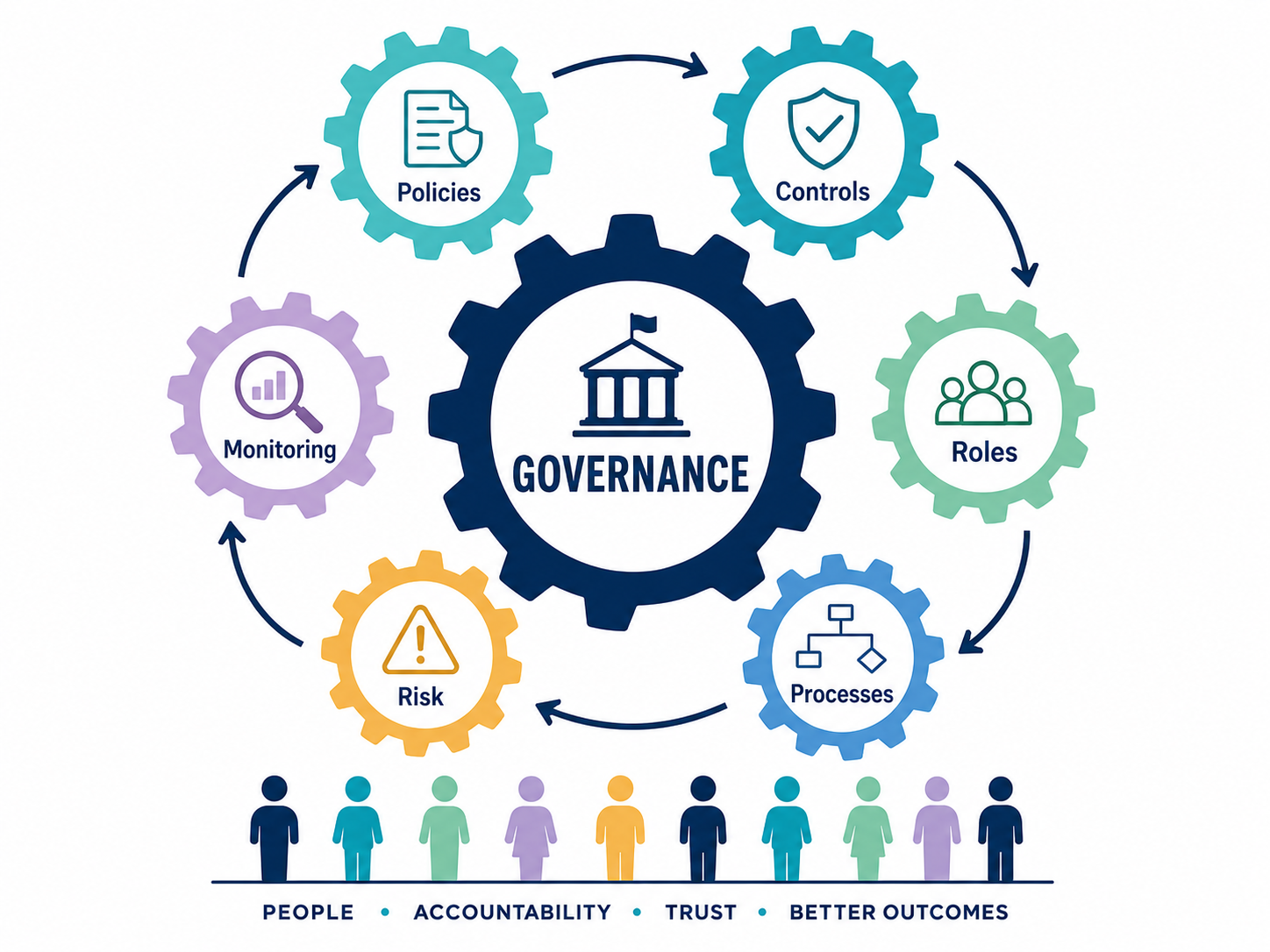
Build governance into the project from the start
AI governance should not be added at the end of a software project. It should form part of the planning, design, development, testing, and maintenance process.
Strong governance helps the business decide:
• which AI features are acceptable
• which data may be used
• who approves AI related decisions
• how outputs are checked
• when human review is required
• how errors are reported
• how risks are monitored after launch
This is where many AI projects fail. The technical feature may work, but the business has no clear accountability around how it is used.
For South African companies, governance should also consider POPIA, cybersecurity controls, supplier risk, and contractual responsibilities. If an external platform or service provider is involved, the organisation should understand where data is processed, how it is protected, and what happens if something goes wrong.
Protect personal information and business data
AI systems depend on data. That makes information protection one of the most important considerations in custom software development.
Before using AI in a system, companies should ask:
• What data will be processed?
• Does the AI feature need personal information to work?
• Can the data be reduced, masked, or anonymised?
• Who can access the AI outputs?
• Will the data be shared with a third party?
• Is the data being used for a purpose the organisation can justify?
• How long will the data and outputs be retained?
These questions are not only technical. They are governance questions. If AI is used in recruitment, customer support, finance, training, or compliance systems, the organisation must understand the privacy and security impact.
A disciplined approach helps reduce exposure. It also supports improved trust because employees, customers, and partners can see that the organisation is not using AI carelessly.
Do not compromise software quality
AI assisted development can speed up delivery. Developers can use AI tools to support code suggestions, documentation, testing ideas, and problem solving. However, speed should never replace quality.
South African organisations should still expect:
• clear software architecture
• secure coding practices
• code review
• software testing
• user acceptance testing
• documentation
• version control
• change management
• maintenance planning
AI generated code can contain errors, security weaknesses, or logic that does not fit the business context. It must be reviewed by competent developers before it becomes part of a live system.
The same applies to AI features inside the software. A model may produce useful outputs during testing, but perform poorly when exposed to real business data, unclear user prompts, or unusual cases. Testing must therefore include accuracy, security, usability, and failure scenarios.
Keep human oversight in place
AI should support people, not remove accountability. This is especially important when the system affects customers, employees, suppliers, learners, or regulated decisions.
Human oversight may include:
• review of AI generated recommendations
• approval before sensitive actions are taken
• escalation rules for uncertain outputs
• manual review of complaints or exceptions
• periodic checking of system performance
• monitoring for biased or inaccurate results
For example, an AI tool may help screen large volumes of support tickets. It can group requests, identify urgent cases, and suggest responses. However, a staff member should still review sensitive matters before communication is sent.
This approach gives companies the benefit of AI without placing full responsibility on the technology.
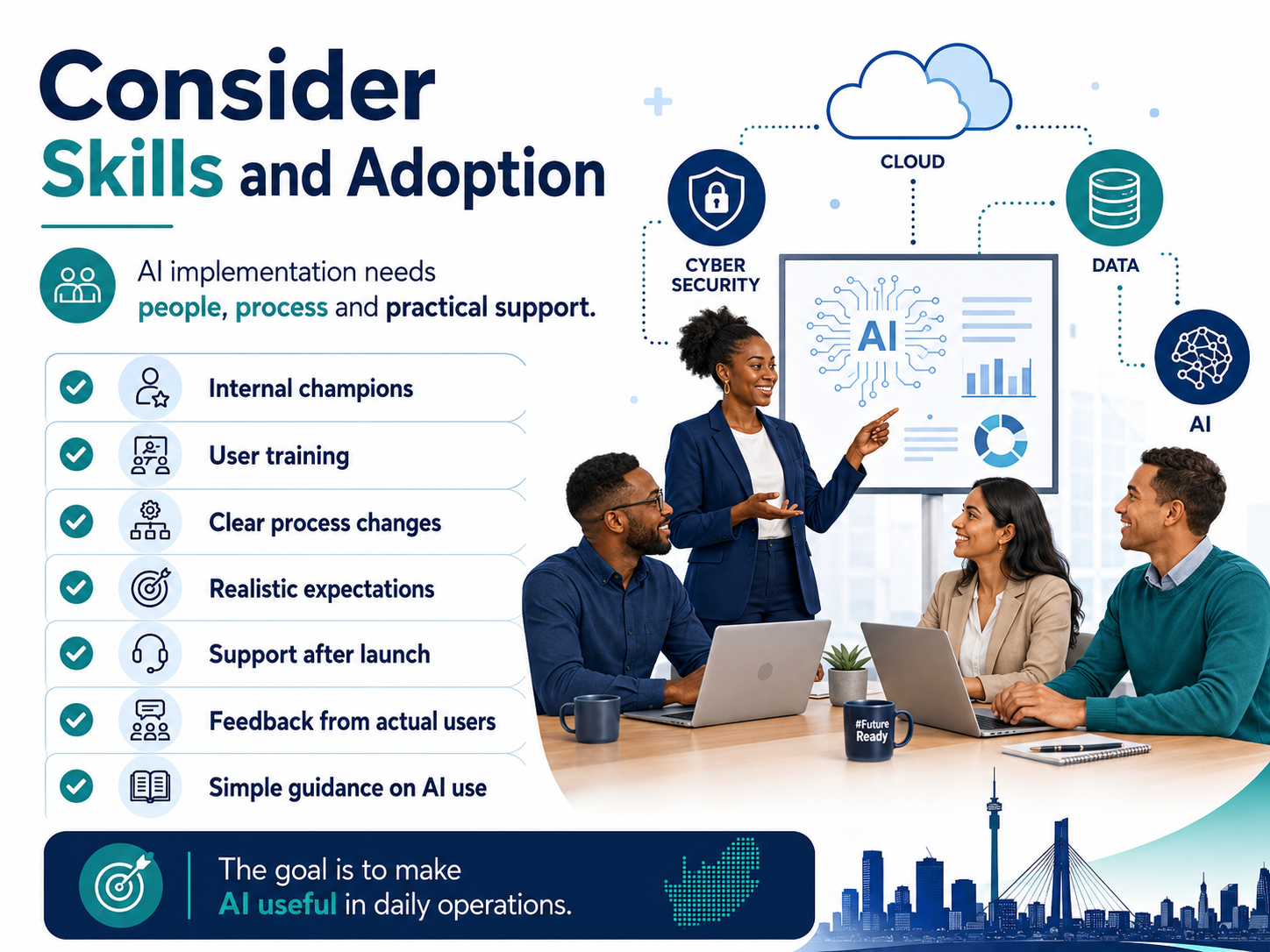
Consider skills and adoption
AI implementation is not only a technical project. It is also a change management project.
South Africa continues to experience pressure around digital skills, including cloud, cybersecurity, data, and AI related capabilities. That affects both delivery teams and business users. A company may build a useful AI enabled system, but fail to gain value because users do not understand it, trust it, or know how to apply it correctly.
Successful adoption requires:
• internal champions
• user training
• clear process changes
• realistic expectations
• support after launch
• feedback from actual users
• simple guidance on what AI can and cannot do
This is where a practical partner can help. The goal should not be to impress users with technical complexity. The goal should be to make the software useful in daily operations.
Example: AI in a custom business system
Consider a South African company that receives large volumes of supplier documents, customer forms, and internal requests. Staff spend hours reading documents, capturing information, checking missing fields, and routing work to the correct team.
A practical AI software development project could include:
• document classification
• extraction of key information
• alerts for missing fields
• routing to the correct department
• summarised notes for staff review
• reporting dashboards for managers
This type of project can save time and reduce manual errors. However, it still needs controls. The company must define which documents may be processed, who can view the outputs, how errors are corrected, and when a human must approve the result.
That is the difference between useful AI and unmanaged automation.
Common mistakes companies should avoid
Several mistakes appear often in AI software projects.
The first is starting with the technology instead of the business problem. This often leads to expensive features that do not solve a real need.
The second is using poor quality data. AI cannot produce reliable outputs if the underlying data is incomplete, outdated, duplicated, or poorly structured.
The third is ignoring governance. Without clear rules, AI features can create confusion around accountability, privacy, and decision making.
The fourth is weak testing. AI features should be tested under realistic conditions, not only in a controlled demo environment.
The fifth is poor adoption planning. Users need to understand how the system supports their work, where its limits are, and when to escalate issues.
What South African companies should ask before starting
Before investing in AI enabled custom software development, companies should ask:
• Is the business problem clear?
• Does AI add real value to the process?
• What data will be used?
• Are there privacy or security risks?
• What controls are required?
• Who will approve and monitor the AI feature?
• How will the system be tested?
• How will users be trained?
• How will success be measured after launch?
These questions help prevent rushed implementation. They also help the organisation build software that is practical, secure, and aligned with business needs.
WWISE’s thoughts on AI software development
The most successful AI software projects in South Africa will not always be the flashiest. They will be the ones with a clear problem statement, strong governance, realistic implementation, reliable testing, and measurable business value.
AI can strengthen custom software development, but it works best when treated as a capability within a disciplined delivery model. It should not be used as a shortcut around planning, security, testing, documentation, or human accountability.
For South African companies, the opportunity is clear. AI can help organisations work faster, make improved use of information, and create smarter systems. The challenge is to implement it responsibly.