






Course Summary
The ISO 14001:2026 Environmental Management Systems (EMS) Lead Auditor Course provides participants with the knowledge, skills and practical competence required to plan, conduct, report and follow up on Environmental Management System audits in accordance with ISO 14001:2026 and the principles and guidelines for auditing management systems.
The course takes participants through the complete audit process, from establishing an audit programme and preparing an audit plan to conducting interviews, gathering objective evidence, evaluating conformity, identifying nonconformities, preparing audit reports and conducting follow-up activities.
The course places strong emphasis on practical auditing skills, risk-based thinking, environmental performance, leadership, organisational context, compliance obligations, life-cycle considerations, climate-change considerations, operational controls and continual improvement.
Who Should Attend?
This course is designed for individuals involved in
- Environmental Managers and Environmental Officers
- EMS Managers and Coordinators
- ISO 14001 Internal Auditors
- Lead Auditors and prospective Lead Auditors
- Quality, Health, Safety and Environmental (QHSE) Managers
- Integrated Management System (IMS) Managers
- Compliance Officers
- Environmental Consultants
Course Objectives
By the end of this course, participants will be able to:
- Explain the purpose, structure and key requirements of ISO 14001:2026.
- Explain the fundamental principles and concepts of Environmental Management Systems.
- Understand the role and responsibilities of an EMS auditor and Lead Auditor.
- Apply auditing principles and risk-based approaches when conducting EMS audits.
- Understand the requirements of ISO 14001:2026 from an auditor’s perspective.
- Develop an effective EMS audit programme.
- Determine audit objectives, scope, criteria and methodology.
- Prepare an effective audit plan and audit checklist.
- Conduct opening meetings and establish effective communication with auditees.
- Conduct interviews and obtain reliable objective evidence.
- Evaluate environmental processes and controls against audit criteria.
- Identify and evaluate conformity and nonconformity.
- Develop clear, factual and evidence-based audit findings.
- Prepare and classify EMS nonconformity reports.
- Prepare professional audit reports.
- Conduct closing meetings and communicate audit conclusions.
- Evaluate corrective actions and verify their effectiveness.
- Apply sampling techniques and professional judgement during audits.
- Audit environmental aspects, impacts, risks and opportunities.
- Audit compliance obligations and operational controls.
- Evaluate the effectiveness of the EMS and its contribution to environmental performance.
- Identify opportunities for improvement without compromising auditor impartiality.
Course Modules
Module 1: Introduction to Environmental Management Systems
- Environmental management principles
- Sustainability concepts
- Overview of ISO 14001:2026
- Annex SL High-Level Structure
- Benefits of implementing an EMS
- EMS lifecycle
Module 2: Understanding ISO 14001:2026 Requirements
- Clause 4 – Context of the Organisation
- Clause 5 – Leadership
- Clause 6 – Planning
- Clause 7 – Support
- Clause 8 – Operation
- Clause 9 – Performance Evaluation
- Clause 10 – Improvement
- Key considerations for auditors when evaluating each clause
Module 3: Environmental Aspects, Impacts, Risks and Opportunities
- Identification of environmental aspects
- Determination of environmental impacts
- Significance evaluation
- Life-cycle perspective
- Risks and opportunities
- Environmental objectives
- Environmental planning
- Auditor evaluation of environmental aspects and impacts
Module 4: ISO 19011:2026 – Fundamentals of Management System Auditing
- Purpose of management system audits
- First-, second- and third-party audits
- Audit principles
- Auditor competence
- Auditor independence and impartiality
- Confidentiality
- Evidence-based auditing
- Risk-based approach to auditing
- Professional judgement
- Ethical behaviour
Module 5: Audit Evidence, Findings and Nonconformities
- Types of audit evidence
- Objective evidence
- Evidence reliability
- Evaluating evidence
- Conformity
- Nonconformity
- Major and minor nonconformities
- Audit observations and opportunities for improvement
- Writing factual audit findings
- Linking findings to audit criteria
- Evidence-based NCR writing
- Practical NCR-writing exercises
Module 6: Audit Reporting and Closing the Audit
- Preparing audit conclusions
- Audit report structure
- Reporting conformity and nonconformity
- Communicating audit results
- Conducting the closing meeting
- Presenting findings professionally
- Handling disagreements
- Audit confidentiality
- Distribution and retention of audit reports
Module 7: Corrective Action and Audit Follow-Up
- Corrective-action processes
- Root cause analysis
- Correction versus corrective action
- Reviewing proposed corrective actions
- Evaluating implementation
- Verifying effectiveness
- Closing audit findings
- Follow-up audits
- Maintaining audit records
Module 8: Final Practical Audit Simulation and Assessment
- Review an organisation’s EMS information
- Identify audit risks
- Develop an audit plan
- Allocate audit-team responsibilities
- Conduct audit interviews
- Evaluate objective evidence
- Identify audit findings
- Develop nonconformity reports
- Determine audit conclusions
- Present findings to management
- Prepare an audit report
- Evaluate corrective-action responses
Module 9: ISO/IEC 17021-1:2015 Conformity Assessment
- What is ISO/IEC 17021-1?
- Benefits of ISO/IEC 17021-1.
- Steps towards ISO/IEC 17021-1 accreditation.
- Recommendations for implementation.
- Dealing with multiple quality management systems.
- Understanding the ISO/IEC 17021-1 requirements.
- Management requirements.
- Competence requirements.
- Documentation requirements.
- Introduction to the auditing process
Module 10: Preparing for Certification
- Certification process
- Stage 1 Audit
- Stage 2 Audit
- Certification requirements
- Addressing nonconformities
- Maintaining certification
- Continual improvement strategies
Benefits
Participants and organizations will benefit by:
- Develop practical ISO 14001:2026 auditing competence.
- Confidently plan and lead EMS audits.
- Understand the new and revised requirements of ISO 14001:2026 from an auditing perspective.
- Improve the effectiveness of internal EMS audits.
- Identify systemic environmental management weaknesses.
- Produce objective, evidence-based audit findings.
- Improve the quality of corrective-action and follow-up processes.
- Strengthen environmental compliance and risk management.
- Evaluate whether environmental controls are effectively implemented.
- Assess the effectiveness of an organisation’s EMS rather than simply checking documentation.
- Improve organisational environmental performance through effective auditing.
- Develop skills applicable to internal, supplier and third-party audits.
- Strengthen professional competence for individuals pursuing EMS auditor or Lead Auditor careers.
- Support organisations in maintaining and continually improving ISO 14001:2026 certification.
Certification
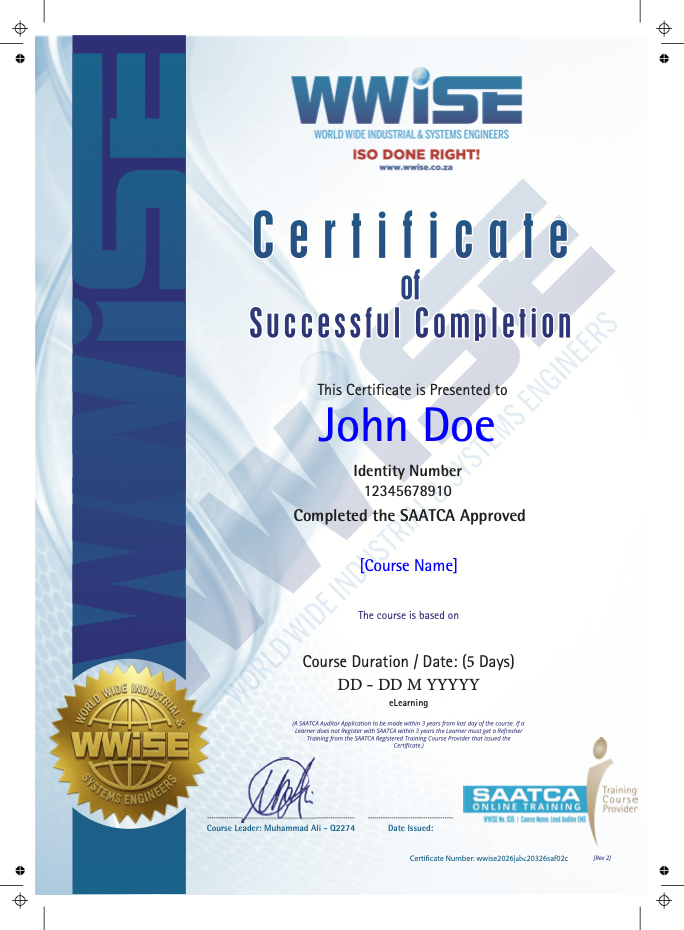
Delegates will receive a Certificate of:
- Attendance or
- Competency
Assessment
An invigilated assessment is required at the end of this course.
- Delegates have to complete the assessment with a minimum score of 70% to receive a Certificate of Competence.
- Delegates who score between 50% and 59% will get a second attempt at the assessment.
- If you fail the second attempt, will need to repurchase the course
- Delegates will receive a Certificate of Attendance regardless of a pass or fail
Please note due to our accreditation with SAATCA, learners enrolled on this eLearning course must reach out to the WWISE Training Department upon completion of the modules to set up invigilation of the exam either virtually over TEAMS or physically at the training centre.
Learning Outcomes
- A comprehensive understanding of ISO 14001:2026 EMS requirements.
- Practical knowledge of EMS auditing principles and techniques.
- The skills required to plan and conduct effective EMS audits.
- Improved ability to identify environmental risks and compliance issues.
- Increased confidence in interviewing auditees and gathering objective evidence.
- The ability to identify and document nonconformities.
- Practical experience in preparing audit plans, checklists, and reports.
- Improved understanding of corrective action and follow-up processes.
- Knowledge of how to lead and manage an audit team.
- Enhanced professional auditing and environmental management competence.
- A foundation for conducting internal, supplier, and external EMS audits, subject to applicable competency and certification requirements.

CERTIFICATE PREVIEW