






Course Summary
This course equips delegates to plan, conduct, report and follow up internal audits of an Environmental Management System against ISO 14001:2026, applying the guidance in ISO 19011:2026. Delegates work through each clause of the revised standard, learn what auditors look for and how to audit it, and then learn the full audit process from programme management through to follow-up. The course closes with the certification and surveillance cycle and an open-book assessment.
Who Should Attend?
This course suits anyone who audits, or supports the audit of, an Environmental Management System in organisations of any size or sector:
• Internal auditors and aspiring internal auditors
• Environmental, sustainability and SHEQ managers and officers
• EMS representatives and management system coordinators
• Compliance, risk and quality professionals
• Team leaders and managers who are audited or contribute to the EMS
• Professionals preparing for ISO 14001 certification or transition from the 2015 edition
Course Objectives
By the end of the course, the learner will be able to:
• Explain the role of ISO, the difference between accreditation and certification, and the purpose and structure of ISO 14001:2026.
• Describe the key changes from ISO 14001:2015, including stronger climate and biodiversity focus, life-cycle perspective, externally provided processes, planning of change (Clause 6.3) and leadership accountability.
• Interpret the requirements of Clauses 4–10, including the expected outputs and audit evidence for each.
• Apply the principles of auditing and the guidance of ISO 19011:2026 to manage an audit programme and conduct an audit.
• Collect and verify audit evidence, generate findings, grade nonconformities and record conformities.
• Conduct opening and closing meetings, prepare and distribute an audit report, and carry out audit follow-up.
• Demonstrate professional auditor conduct and describe the competence expected of an auditor.
• Describe the certification process, surveillance cycle and what to expect during an external audit.
Course Modules
Day 1 — Foundations of ISO 14001:2026
• Welcome, ground rules, course information and assessment criteria
• Who is ISO? Institutional hierarchy and accreditation vs certification
• Background to ISO 14001:2026, key changes from 2015, and why the standard matters
• Purpose of ISO 14001:2026; key terms and definitions
• The PDCA cycle, high-level structure and sub-clauses of the standard
• Components of a management system (documentation hierarchy)
• Clause 4 — Context of the organisation, and how to audit it
• Clause 5 — Leadership, and how to audit it
• Clause 6 — Planning (aspects and impacts, compliance obligations, risks and opportunities, objectives, planning of change), and how to audit it
Day 2 — Completing the Standard and Introducing ISO 19011:2026
• Clause 7 — Support, and how to audit it
• Clause 8 — Operation, and how to audit it
• Clause 9 — Performance evaluation, and how to audit it
• Clause 10 — Improvement, and how to audit it
• Introduction to auditing: what an audit is, why we audit, the value and limits of auditing
• Types of audits (system, process, product) and audit parties (1st, 2nd, 3rd party); audit documentation
• Risk-based thinking and the 5 C’s of auditing
• ISO 19011:2026 Clauses 1–3 (scope, normative references, terms and definitions)
• ISO 19011:2026 Clause 4 — Principles of auditing
• ISO 19011:2026 Clause 5 — Managing an audit programme (objectives, risks and opportunities, roles, scope, resources,
implementation, monitoring, review and improvement)
Day 3 — Conducting Audits, Certification and Assessment
• ISO 19011:2026 Clause 6 — Conducting an audit:
o Initiating the audit and determining feasibility
o Preparing audit activities: document review, audit plan, work assignments, working documents
o Conducting audit activities: opening meeting, communication, collecting and verifying evidence, document review quality checks, generating findings, grading nonconformities, recording conformities and nonconformities, audit conclusions, closing meeting
o Preparing and distributing the audit report
o Completing the audit and conducting follow-up; monitoring corrective action
o Audit sampling and summary of the internal audit process
• ISO 19011:2026 Clause 7 — Competence and evaluation of auditors
• Auditor conduct, etiquette and common pitfalls; audit plan vs audit programme
• Module 4 – Certification process, annual surveillance audits and what to expect during an audit; ISO management system maintenance
• Course revision and exam preparation
• Open-book examination
Benefits
• Understand the revised ISO 14001:2026 requirements and the key changes from the 2015 edition.
• Develop practical skills to plan, conduct, report and follow up on internal audits in line with ISO 19011:2026.
• Identify audit evidence, document findings and grade nonconformities effectively.
• Support environmental compliance, risk management, continual improvement and readiness for certification and transition to the revised standard
• Promote improved environmental performance through effective management of environmental risks, waste, energy use and costs.
• Earn a Certificate of Competence by achieving 70% or higher in the open-book examination.
Certification
- All delegates who successfully pass the assessment over 60% will be issued with a certificate of competence.
- If you receive lower than 60% a certificate of attendance will be issued.
Assessment
- An Assessment at the end of the course will be required.
- A minimum of 60% is to be achieved to attain a Competence Certificate.
- If you achieve lower than 60% but get between 40 – 59% a second attempt will become available.
- If you get lower than 40% and fail the second attempt, you will need to re-purchase the course.
- An attendance certificate is awarded to you regardless of a pass or fail.
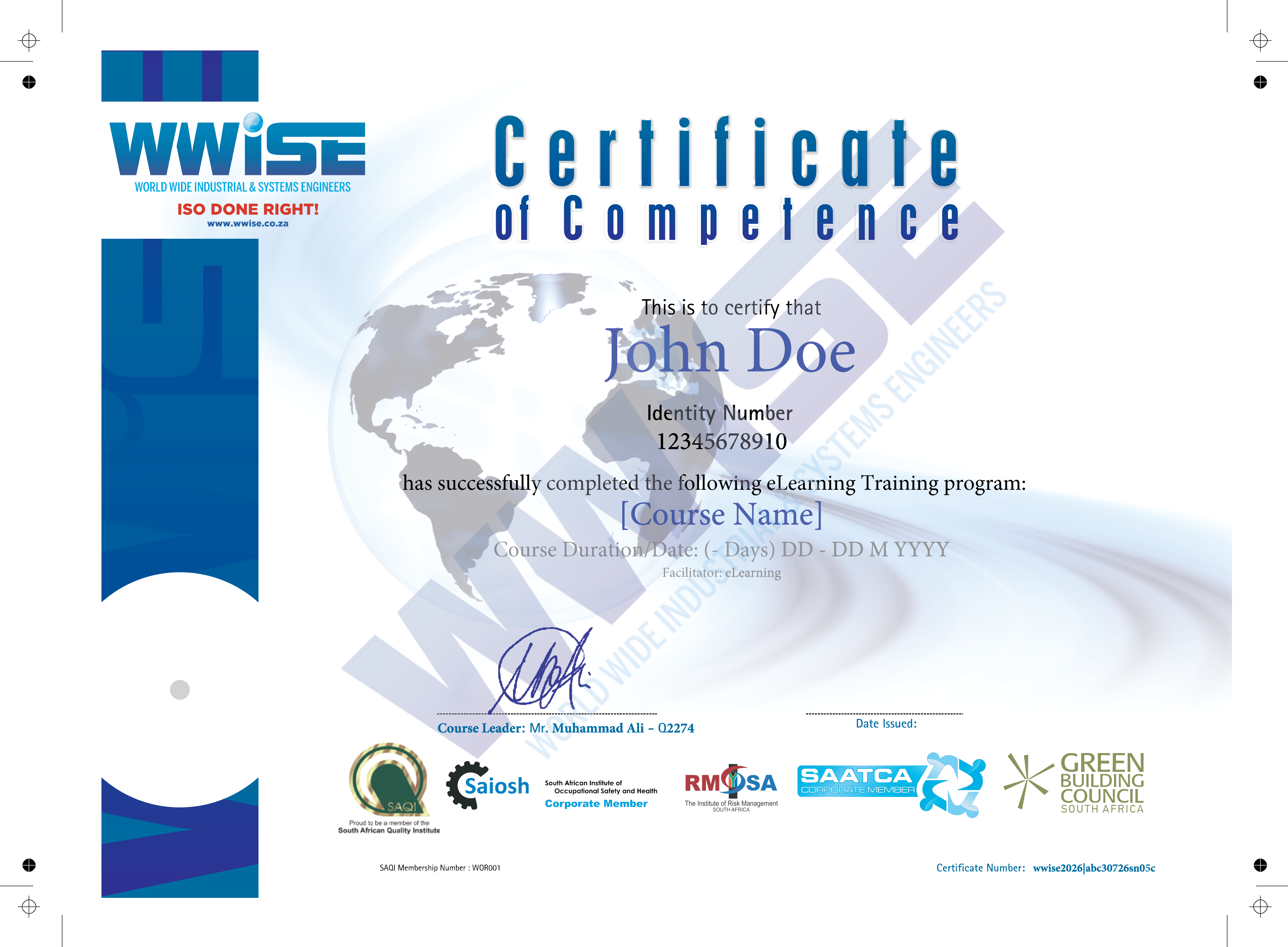
Learning Outcomes

CERTIFICATE PREVIEW