







ISO 27001 training for beginners should make information security relevant to a learner’s role before introducing advanced implementation or audit work. ISO/IEC 27001:2022 sets requirements for an information security management system, or ISMS, that manages risks to the confidentiality, integrity, and availability of information. Employees need practical awareness, while ISMS managers, risk owners, technical specialists, and auditors need progressively deeper skills. Choosing the correct starting course prevents people from being overwhelmed by terminology and prevents employers from mistaking course attendance for operational competence.
ISO 27001 training for beginners starts with awareness
Awareness training is appropriate for most employees, contractors, and new starters. It should explain why information has value, common threats, expected behaviour, and how the organisation’s ISMS affects daily work. Relevant topics include secure authentication, phishing, device and remote-working security, information classification, physical security, incident reporting, supplier risks, and responsible handling of personal information.
The course should connect to the organisation’s actual policies and reporting channels. A learner must know whom to contact, what constitutes a suspected incident, and what immediate actions are safe. Short, repeated learning and realistic exercises can reinforce behaviour better than an annual compliance presentation.
Awareness training does not make somebody an ISO/IEC 27001 implementer, cybersecurity engineer, POPIA legal specialist, or auditor. It creates the baseline on which role-specific competence can be built.
Implementation training for ISMS responsibilities
Implementation training suits the ISMS manager, information-security team, privacy and compliance personnel, risk owners, control owners, project managers, and selected business leaders. Learners should understand how to define the ISMS scope, analyse organisational context and interested parties, assess information-security risks, plan risk treatment, define objectives, allocate resources, and monitor performance.
They also need to understand the relationship between the main requirements, the Statement of Applicability, and Annex A controls. Annex A is not a universal checklist that every organisation applies identically. Control selection should follow risk assessment, legal and contractual obligations, and the organisation’s context, with exclusions and inclusions justified appropriately.
Practical implementation training should use a case study or workplace assignment. Useful outputs include a draft scope, asset and process view, risk criteria, sample risk assessment, treatment plan, Statement of Applicability entry, competence plan, supplier control, or monitoring measure.
Courses for technical and control owners
ISO/IEC 27001 training explains the management system; it does not replace specialist training in cloud security, secure development, networking, incident response, privacy law, or business continuity. Technical teams may need both.
A control owner should understand the control objective, risk addressed, responsibilities, operational evidence, monitoring, exceptions, and escalation. Human resources may focus on screening, terms, awareness, and exit processes. Procurement may focus on supplier due diligence and contracts. ICT teams may need deeper technical learning. Legal or privacy teams should connect POPIA duties to ISMS processes without assuming that certification guarantees legal compliance.
Match the course to the control owner’s decisions. Generic awareness is too shallow for somebody designing a control, while full Lead Auditor training may be unnecessary for a system administrator who needs focused implementation skill.
Internal auditor and Lead Auditor pathways
Internal auditor training is suitable for employees who will evaluate the ISMS. Learners need prior knowledge of ISO/IEC 27001 and should practise audit planning, sampling, interviews, evidence evaluation, finding statements, reporting, and follow-up. The audit team must collectively understand relevant technologies, processes, information risks, and legal or contractual context.
Lead Auditor training is for people who will lead comprehensive audits or teams, conduct significant supplier audits, work towards a certification-audit career, or pursue professional registration. It adds audit leadership and complex decision-making. A course certificate is not automatic professional registration, and certification bodies apply additional competence requirements.
Employers should protect audit objectivity. The person who designed a control should not be the sole person judging whether their own work conforms and is effective.
A beginner’s role-to-course map
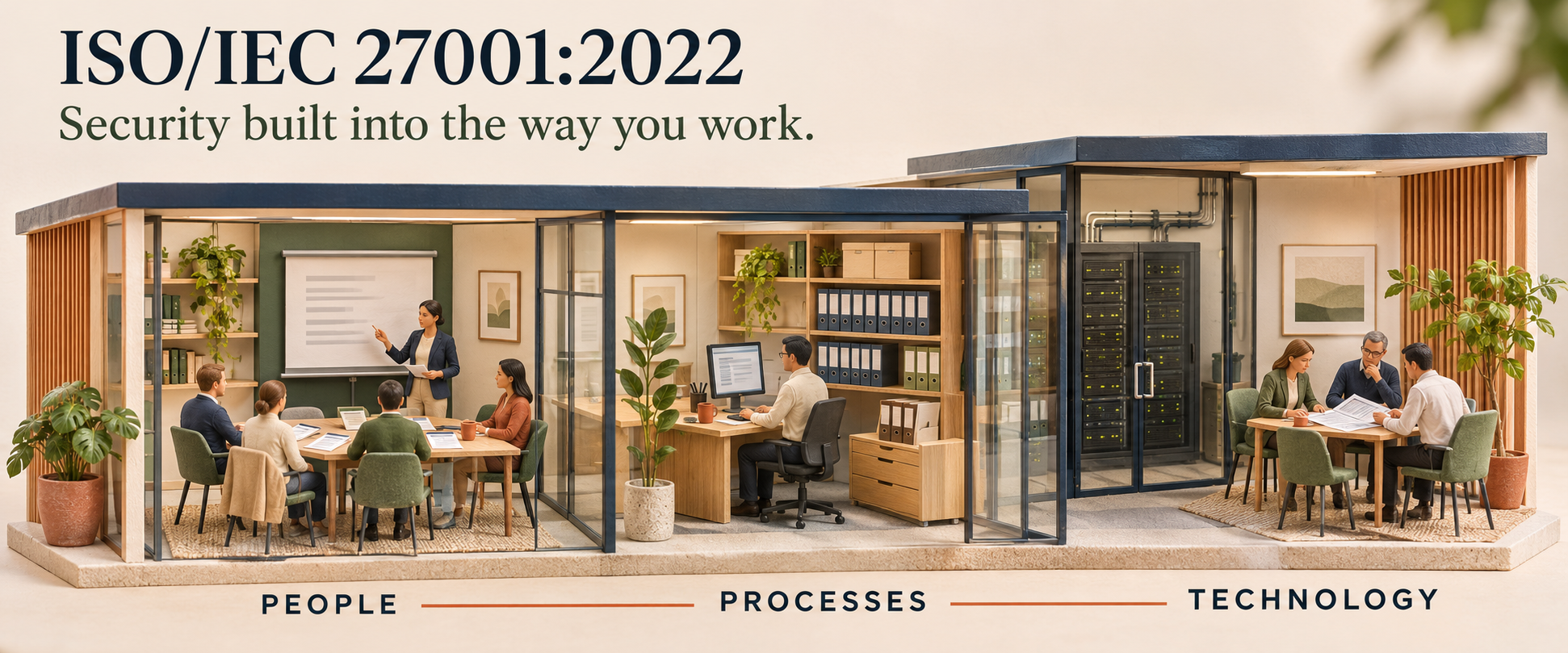
Use this sequence as a starting point:
- All users of information: security awareness and organisation-specific induction.
- Managers and risk or control owners: awareness plus role-specific risk and control training.
- ISMS implementation team: ISO/IEC 27001 implementation training and practical assignments.
- Internal auditors: standard knowledge, internal auditor training, and supervised ISMS audits.
- Audit leaders: Lead Auditor training plus relevant technical, sector, and audit experience.
- Board and executives: concise governance awareness focused on risk, accountability, resources, and performance.
Review the training matrix after incidents, technology changes, role changes, audits, new legal requirements, or revised risk assessments.
Common beginner mistakes
Do not start by memorising all controls without understanding the organisation’s risks and processes. Do not assume that an ISO/IEC 27001 course is a complete cybersecurity career programme. Avoid selecting an outdated edition or a course that does not explain what its certificate means.
Employers should not measure success only by completion percentage. Test whether learners can identify a phishing attempt, follow classification rules, escalate an incident, perform a risk assessment, or audit a control as appropriate to their role.
Choose the first course that fits your role
Most new learners should begin with ISO/IEC 27001:2022 awareness. ISMS project members can progress to ISO/IEC 27001:2022 implementation training. Browse the information-security course category and confirm the standard edition and auditor-course recognition before enrolment.