







Artificial Intelligence (AI) literacy training helps employees use artificial intelligence with enough knowledge to recognise limits, protect information, verify outputs, and escalate risk. This is becoming a practical workplace requirement as staff use generative AI for research, drafting, analysis, coding, customer support, recruitment, and decision support.
South Africa does not yet have a final national AI policy. The draft published in 2026 was withdrawn and is being reworked. Organisations should not wait for a final policy before setting internal expectations. Training can connect approved tools, POPIA, information security, intellectual property, human oversight, and accountability to the actual tasks employees perform.
Define AI literacy training by role
AI literacy does not mean turning every employee into a data scientist. It means giving each person the knowledge and judgement required by their use of AI. Map who uses, approves, develops, buys, integrates, monitors, or audits AI systems.
All users need a common foundation: what AI can and cannot do, approved use, data handling, output verification, reporting, and responsibility for decisions. Leaders need risk, oversight, and assurance. Developers and product owners need deeper learning on data, testing, change, impact, and monitoring. Procurement needs supplier and contract questions.
The WWISE ISO course catalogue provides related learning in information security, risk, auditing, and management systems. Employers should define their AI competence needs before selecting supporting courses.
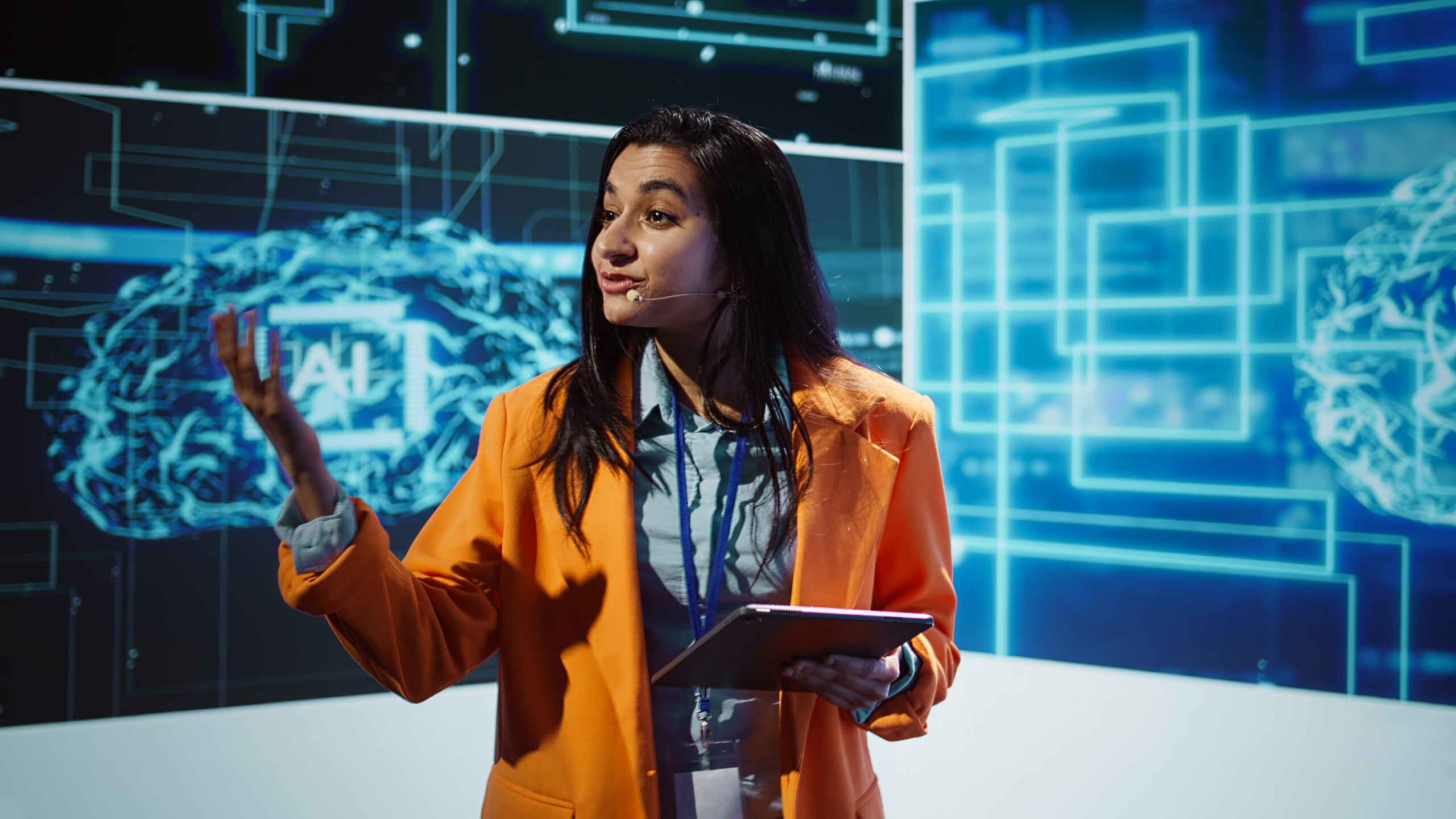
Public speaker doing presentation at tech forum event, explore ways emerging AI technologies can positively enhance companies workforce. Indian woman promoting artificial intelligence solutions
Teach the limits of generated output
Generative AI can produce confident text that is inaccurate, incomplete, biased, outdated, or based on an incorrect interpretation. Learners need a verification method that fits the consequence of the task.
For a low-risk draft, review for facts, tone, confidentiality, and source quality. For legal, safety, financial, medical, employment, or customer decisions, competent human review and approved evidence required. Employees should know when AI output may not be used at all.
Use examples from the workplace. Ask learners to compare an AI answer with an approved procedure, identify unsupported claims, and explain what they would verify. Assessment should test judgement rather than the ability to repeat a definition.
Protect information and intellectual property
Employees may paste personal information, client data, source code, contracts, or internal strategy into an AI service without understanding how the provider handles prompts and files. Training must state which tools are approved, which information is prohibited, and which settings or accounts must be used.
Cover data minimisation, de-identification where appropriate, access control, retention, cross-border processing, supplier terms, and incident reporting. Explain that removing a name may not prevent re-identification when the remaining details are distinctive.
Intellectual property learning should cover source material, licences, confidential information, generated assets, attribution, and approval. The organisation needs a clear route for questions because public tools and provider terms can change.
Connect learning to responsible AI governance
ISO/IEC 42001 specifies requirements for an artificial intelligence management system. NIST’s AI Risk Management Framework provides voluntary guidance for managing AI risk. Both reinforce the need for defined responsibilities, risk management, oversight, monitoring, and improvement.
Training should explain the organisation’s AI inventory, approval route, impact assessment, human oversight, change control, incident process, and monitoring expectations. A user who discovers harmful output, unexpected disclosure, or material performance change must know where to report it.
Leadership learning should include the difference between an AI provider’s assurance and the organisation’s accountability for its own use. A reputable tool can still be used in an unsuitable context or with poor data.
Use scenarios and practice
Create scenarios based on the decisions employees face. A recruiter receives an AI shortlist that excludes a group. A consultant wants to upload a client procedure for summarisation. A developer uses generated code with an unknown dependency. A manager relies on a dashboard explanation that conflicts with the source data.
Ask the learner to identify the risk, permitted action, required verification, and escalation. Give feedback that refers to the organisation’s policy and process. Include examples where AI use is acceptable so that training does not become a list of warnings without practical guidance.
Managers should reinforce the learning during work. If the approved route is unclear or inconvenient, employees may create hidden use rather than ask for help. Training feedback can identify policy gaps and tools that do not support the job.
Measure behaviour and refresh learning
Completion records show participation, not responsible use. Review scenario results, policy questions, reported events, unauthorised tools, data loss indicators, quality failures, and audit findings. Protect employees from surveillance that is unnecessary or disproportionate.
Update content when tools, provider terms, organisational policy, regulation, or use cases change. New users and new roles may need different depth. Keep the approved version and record who received it.
Learners can review ISO/IEC 27001 awareness training to strengthen information security knowledge and risk management courses for structured decision-making. Organisations can speak to a WWISE consultant about a role based learning pathway.
AI literacy training should make responsible use easier to recognise and practise. When learning reflects real tasks, approved tools, verification needs, and reporting routes, employees can use AI productively without treating generated output as unquestionable evidence.